

France Commissions Fourth Barracuda-Class Nuclear-Powered Attack Submarine
Defence Desk #
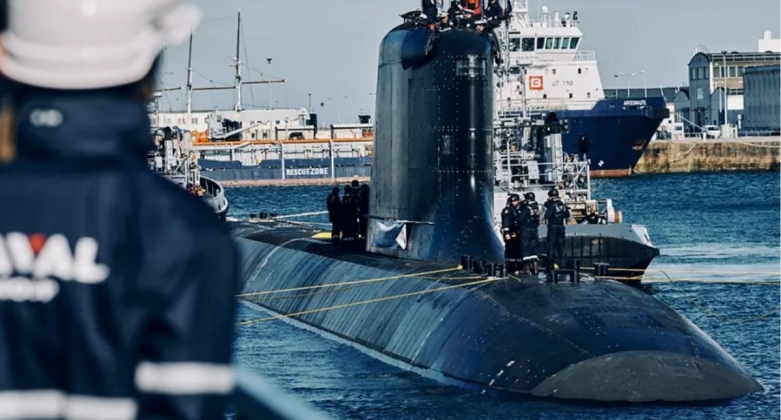
France has taken another major step in strengthening its undersea warfare capabilities with the delivery of the fourth Barracuda-class nuclear-powered attack submarine (SSN), De Grasse (S637).
French shipbuilder Naval Group officially handed over the submarine to the French Defence Procurement Agency (DGA) and the French Navy (Marine Nationale) on 24 June 2026, following the successful completion of an extensive four-month sea trial program.
The delivery marks another milestone in France’s Barracuda Programme, which is replacing the aging Rubis-class attack submarines with a new generation of highly capable nuclear-powered vessels. With the commissioning of De Grasse, the French Navy now operates four Barracuda-class submarines.
Advanced Design and Propulsion
The Barracuda-class submarine has a submerged displacement of approximately 5,300 tonnes, measures 99.5 metres in length, and has a beam of 8.8 metres. It can reach speeds of up to 25 knots (around 46 km/h) while submerged and accommodates a crew of approximately 65 officers and sailors.
Power is provided by a 150-megawatt K15 Pressurized Water Reactor (PWR), which drives two electric propulsion motors. The submarine is also equipped with two emergency electric motors and a highly efficient pump-jet propulsor, significantly reducing acoustic signatures and improving stealth during underwater operations.
Once refuelled, the reactor can operate for around 10 years without replacement. Although its nuclear propulsion gives it virtually unlimited operational range, the submarine can typically remain at sea for up to 70 days, limited mainly by food and other onboard supplies.
To support prolonged underwater missions, the vessel features onboard oxygen generation systems, carbon dioxide removal equipment, advanced air purification technology, and modern waste management systems.
Powerful Weapons Suite
The submarine is armed with four 533mm torpedo tubes, capable of launching heavyweight torpedoes, anti-ship missiles, land-attack cruise missiles, and naval mines.
It can carry a total of 24 weapons, including four loaded in the torpedo tubes and 20 stored internally.
Its primary armament includes:
F21 heavyweight torpedoes
Exocet SM39 Block 2 anti-ship missiles
MdCN (SCALP Naval) land-attack cruise missiles
FG-29 naval mines
The Barracuda class is also designed to support special forces operations, intelligence gathering, surveillance missions, and anti-submarine warfare.
Unlike France’s strategic ballistic missile submarines, the Barracuda-class is not designed to carry submarine-launched ballistic missiles (SLBMs) or nuclear strategic missiles. Instead, it is optimized for conventional underwater combat, precision strikes against land and naval targets, and covert operations.
Strengthening France’s Naval Power
According to publicly available information, the French Navy currently operates nine nuclear-powered submarines. These include four Triomphant-class ballistic missile submarines (SSBNs), four Barracuda-class attack submarines, and one remaining Rubis-class attack submarine, which is expected to be retired in 2027.
France plans to build a total of six Barracuda-class submarines by 2030. The final two boats, Rubis and Casabianca, are currently under construction. Once all six submarines enter service, they are expected to significantly enhance France’s underwater warfare capabilities, intelligence-gathering capacity, and long-range precision strike capability.#